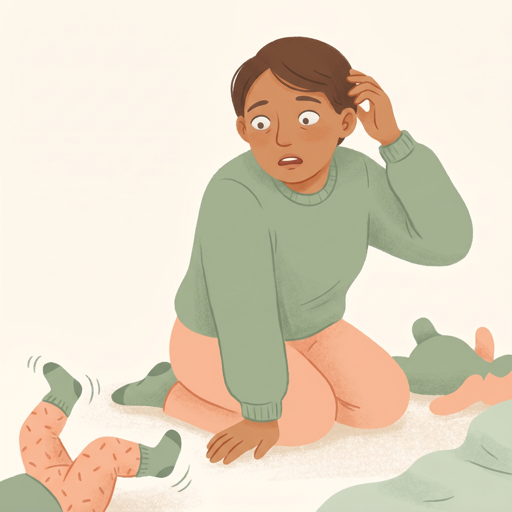
LittleAnchor guides parents through their child's emotional meltdowns — step by step, in the moment — with calming activities backed by child development science.
No reading required. LittleAnchor is built for the moment the meltdown is already happening.
Select your child's age and how intense the moment feels — mild, moderate, or intense. Optionally name the emotion. That's it.
The app selects a short sequence of age-appropriate cards — breathing, movement, and grounding activities — tailored to your child's emotion and intensity level.
Log a quick note, mark what helped, and check in on how you're doing too. Over time, you'll see patterns and know exactly what works for your child.
Every card, every sequence, every prompt in LittleAnchor is grounded in child development and neuroscience research — not guesswork.
When a child is overwhelmed, their prefrontal cortex — the thinking brain — goes offline. Breathing and movement re-engage the nervous system first. That's the only path back to calm, and why LittleAnchor always starts with the body.
Children co-regulate with the adults around them — their nervous systems are not yet self-sufficient. A dysregulated parent cannot regulate a dysregulated child. LittleAnchor starts every session by anchoring you first, because your calm is the first tool.
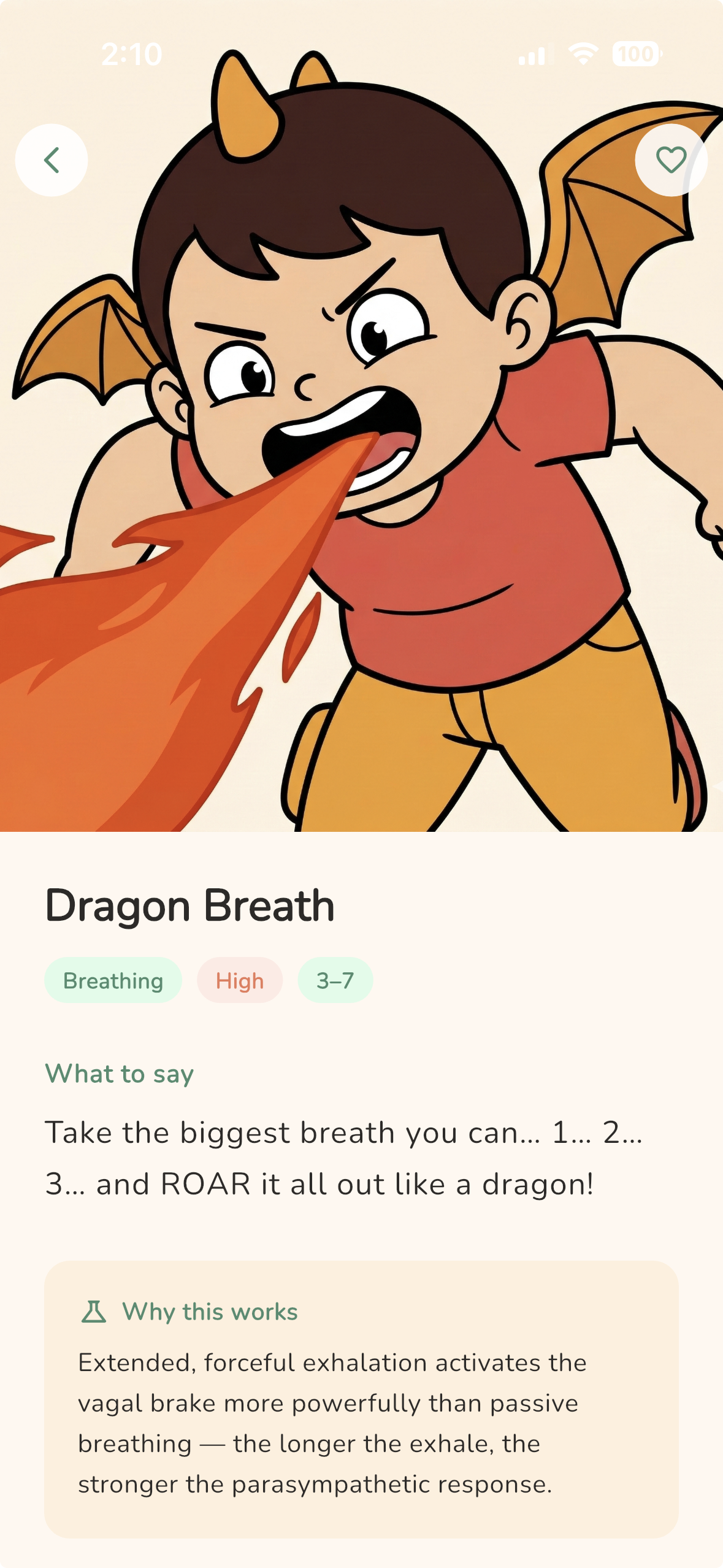
High-intensity moments need movement first to discharge the charge. Lower-intensity moments respond to breathing. Every Calm Path sequence is mapped to what the research says works for that specific emotional state — not one-size-fits-all.
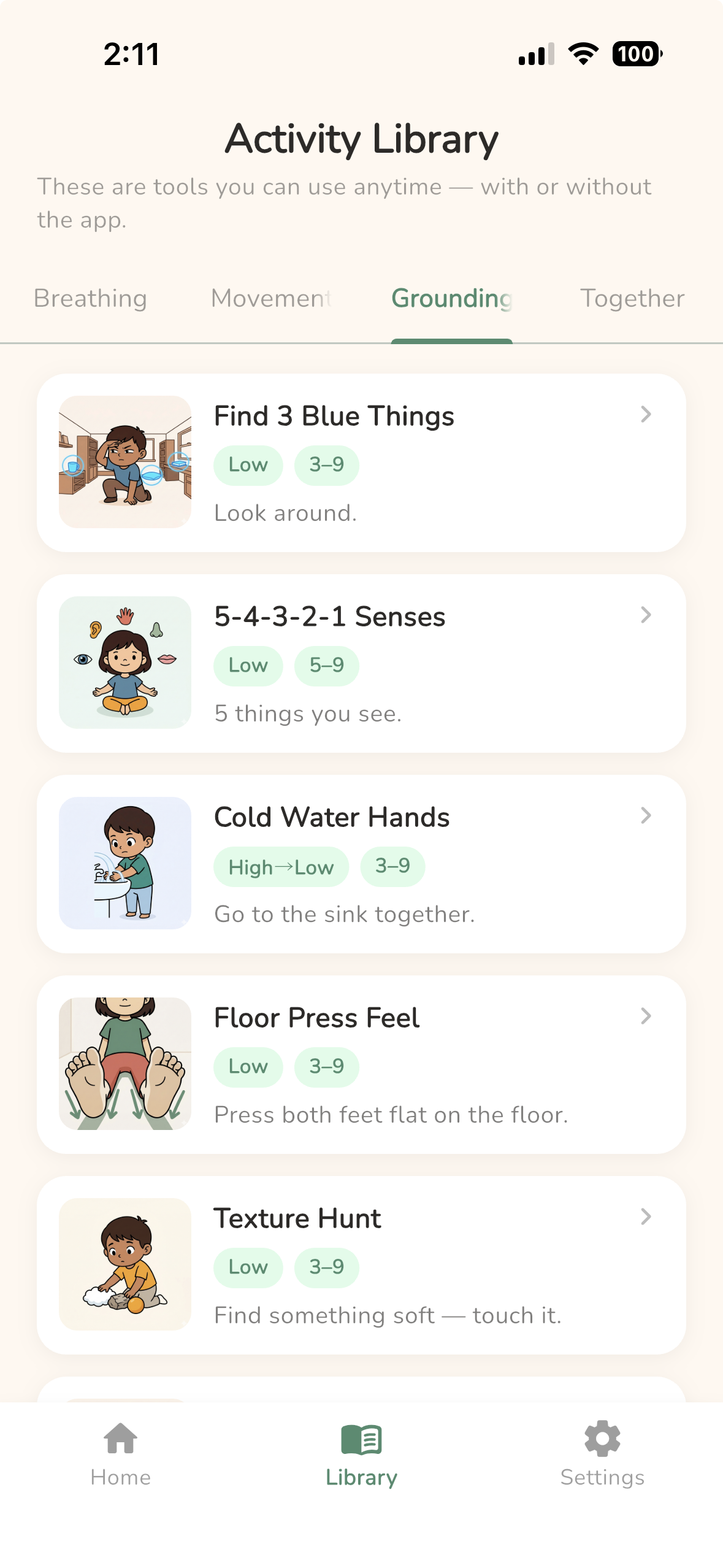
The Activity Library is for the quiet Tuesday afternoon — when you and your child can try a breathing exercise together, find what clicks, and build a shared toolkit before the storm arrives.
When emotions run high, kids need tools they already recognize. The Library is how you get there — 83 evidence-based cards across Breathing, Movement, Grounding, and Co-Regulation, available with Premium.
Breathing
Movement
Grounding
⭐ Co-Regulation
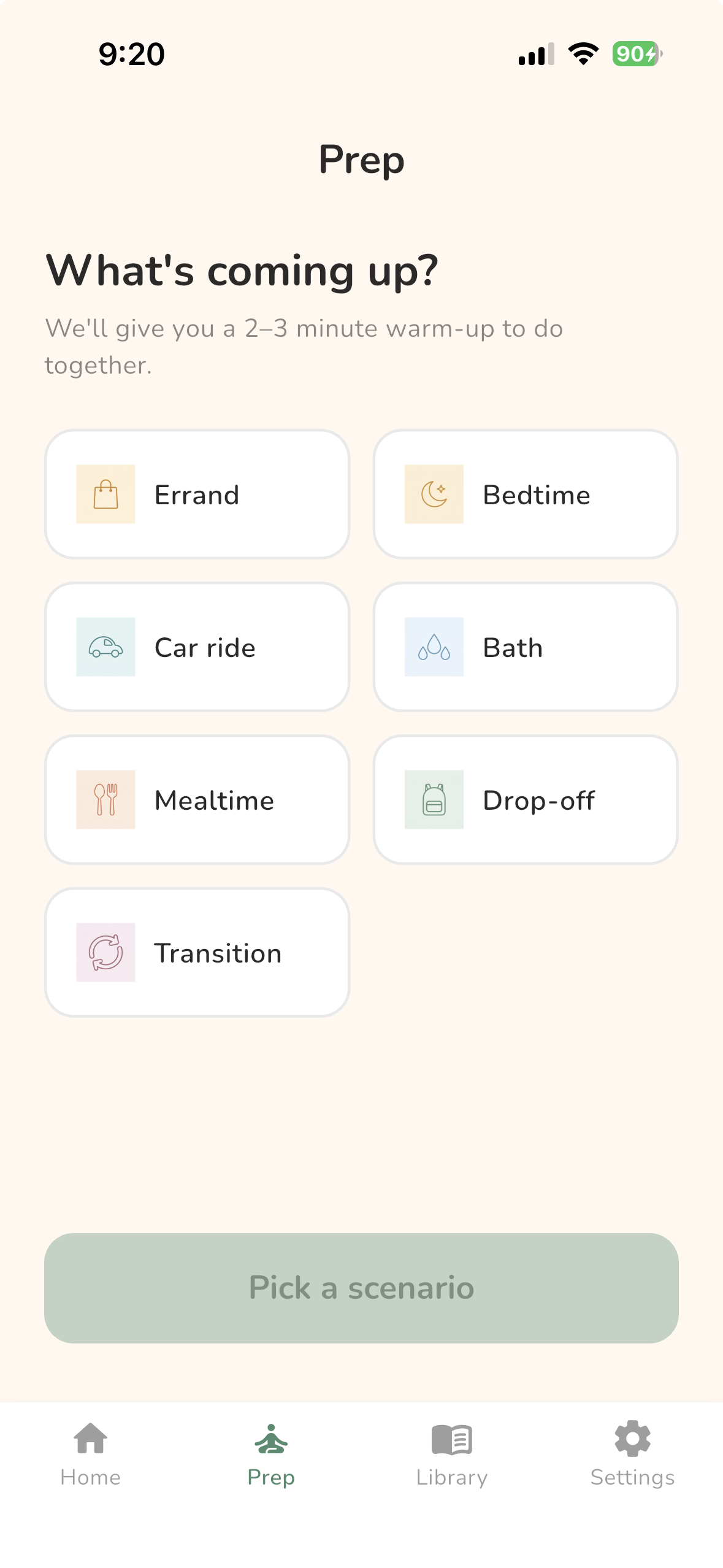
Bedtime resistance. Leaving the park. School drop-off. Car rides. Some moments are predictably hard — and a little calm before them goes a long way.
LittleAnchor includes 7 scenario guides — each with context on why it's hard for kids, a 2–3 minute warm-up activity, and a calming send-off script. All 7 scenarios are free. Premium unlocks a rotating pool of suggestions drawn from the full 83-card library, filtered by your child's age.
Errand
Bedtime
Car ride
Bath
Mealtime
Drop-off
Transition
Built around one idea: the parent is the tool. LittleAnchor makes sure you always know what to do next — in the moment and between the hard ones.
A curated sequence of calming techniques the moment a meltdown starts. Adapts to your child's age, emotion, and intensity — high-intensity starts with movement, lower ones with breathing, always ending in grounding.
Seven scenario guides for the moments you know are coming — bedtime, drop-off, errands, and more. Each gives you context on why it's hard, a warm-up activity, and a send-off script.
Log what happened, mark what helped, and check in on your own state. A small ritual that reminds you that you showed up — and starts building a picture of what works.
A new bite-sized insight from child development research every morning. Co-regulation facts, nervous system science, practical strategies — without asking for extra time.
Add a profile for each child. LittleAnchor remembers their age group so the right cards and sequences are always ready for the right kid.
Browse all 83 illustrated cards across 5 categories — Breathing, Movement, Grounding, Co-Regulation, and Parent. Explore during calm moments so your child already trusts the tools when things get hard.
Every session saved and browsable — grouped by week, per child profile. Scroll back, see the arc, and understand your child's emotional landscape over time.
A 30-day dashboard: when meltdowns peak, top triggers, which cards help most, and whether intensity is trending up or down — with coaching on what to do about each.
Premium Prep rotates through a curated pool of Breathing, Movement, and Grounding cards per scenario — age-filtered so your child never repeats the same warm-up. Free Prep uses one fixed card per scenario.
10 cards in the Library just for you — breathing, grounding, and mindset resets for the moments when your own nervous system needs attention first. Because you can't pour from an empty cup.
The core tools are always free. Premium gives you the full picture — patterns, history, and the insight to understand your kid better over time.
LittleAnchor is designed for children ages 3–9. The app has two age bands — Little Ones (3–5) and Big Kids (6–9) — and automatically adjusts card language, breathing complexity, and technique selection based on your child's profile.
Yes — no credit card, no trial period. The free version includes the full Calm Path for any meltdown, all 83 cards in the Library, all 7 Prep scenarios, Daily Calm Tips, After the Storm reflection, and multiple child profiles. Premium unlocks session history, the Patterns dashboard, and a rotating Prep card pool.
Co-regulation is the process by which a calm, regulated adult helps a dysregulated child return to calm. Children's nervous systems are not yet fully developed — they literally borrow regulation capacity from the adults around them. LittleAnchor is built around this: every session starts by helping the parent anchor first, because a dysregulated parent cannot regulate a dysregulated child.
Most calming apps give the child something to do. LittleAnchor guides the parent — with a self-anchor moment first, then sequences activities based on your child's specific emotion and intensity level. It's built for the moment things are already falling apart, not as a daily mindfulness habit. Every card also includes a coaching note just for you: what to say, what to avoid, and what's happening in your child's nervous system.
Yes. LittleAnchor's techniques — breathing, movement, grounding, and co-regulation — are evidence-based approaches used by occupational therapists, child psychologists, and behavior specialists for anxiety, ADHD, sensory processing differences, and general emotional dysregulation. The app is not a replacement for professional support, but it gives parents practical, in-the-moment tools to reach for.
Yes. All data — child profiles, session history, notes — stays entirely on your device. LittleAnchor does not require an account, does not collect personal information, and does not transmit any data off your phone. See our Privacy Policy for full details.